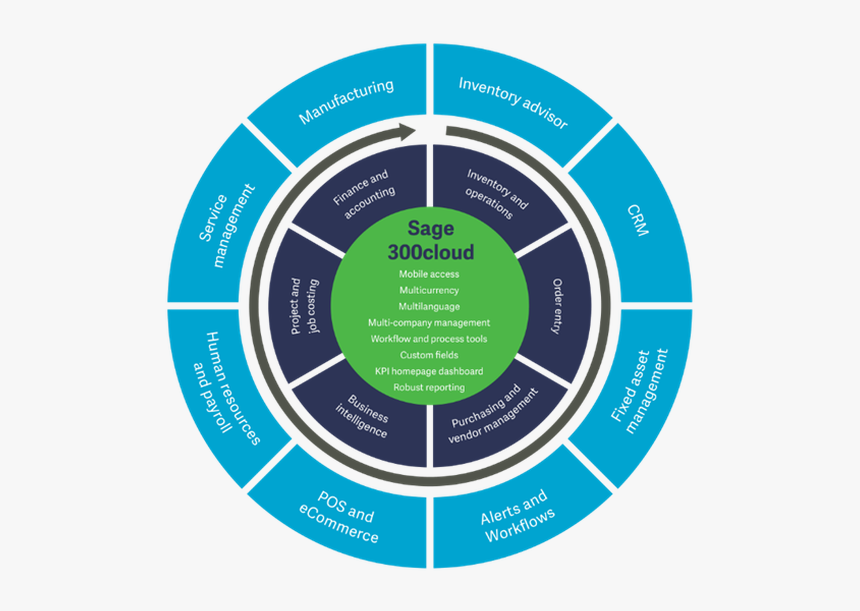
SAGE 300 ERP
Capital allowance has always been one of the quiet workhorses of corporate tax planning in Nigeria — the mechanism that lets a company recover, over time, the cost of the fixed assets it buys to run its trade. With the Nigeria Tax Act (NTA) 2025 now in force from 1 January 2026, that mechanism has been rebuilt from the ground up. Companies that simply carry over their old capital allowance templates into the new year risk under-claiming, over-claiming, or falling foul of conditions that never existed before. Here is what has changed, and what finance teams need to do about it.
A New Legal Home for Capital Allowance
Capital allowance is now governed by Section 27 of the NTA 2025, read together with the First Schedule to the Act. The Companies Income Tax Act framework that previously housed these rules has been repealed.
Administration, assessment, and audit of claims now sit with the Nigeria Revenue Service (NRS), established under the Nigeria Revenue Service (Establishment) Act, 2025.
The Old Four-Part Test Is Gone
For decades, an expense qualified for allowance if it was incurred "wholly, exclusively, necessarily and reasonably" for the business. That test has been replaced. Under the new Act, a capital allowance claim now stands on two conditions instead:
- The asset must be used to generate the company's assessable profits. If an asset sits idle or is used for a non-business purpose, the claim doesn't hold.
- The expenditure must qualify as capital expenditure, and the underlying transaction must be tax-compliant. VAT must have been charged and paid where applicable and import duty must have been settled on imported assets. Section 27(2) is explicit on this point: capital allowance is disallowed where VAT
or import duty on the asset was not paid at acquisition.
This second condition is a genuine departure. It ties a company's ability to claim relief on an asset directly to its indirect tax compliance at the point of purchase — effectively an anti-avoidance measure discouraging under-the-table imports and undocumented purchases. Finance teams that have historically been relaxed about retaining VAT invoices or customs documentation for asset purchases will need to tighten that up, because a missing receipt can now cost a real tax deduction.
Straight-Line Allowance Replaces Initial and Annual Allowances
The initial allowance (a one-off deduction in the year an asset is bought) and the separate annual allowance system have both been abolished. In their place is a single, uniform straight-line annual allowance: - One flat annual rate is applied to the qualifying cost of the asset each year, for as long as it is used in the business.
- There is no upfront initial allowance in the year of acquisition - relief now accrues evenly over the asset's use.
- The balancing allowance and balancing charge regime, which used to true up over- or under-claimed relief on disposal, no longer applies in that form.
- A notional residual value equal to 1% of the qualifying cost must always be retained in the books until the asset is actually disposed of. An asset can never be written down to zero while it is still on the books.
For companies used to front-loading relief through a generous initial allowance, this is a real cashflow and tax-planning shift - deductions are now smoother, but slower, over an asset's life.
The New Rate Structure Rather than the old asset-by-asset schedule, the First Schedule now groups qualifying assets into three broad rate bands:
Annual Rate Applies To 10% per year Buildings expenditure, agricultural expenditure, masts and
communication infrastructure, heavy transportation assets, intangible assets expenditure.
20% per year Plant expenditure, agricultural equipment expenditure, furniture and fittings, mining plant and equipment, other equipment.
25% per year Motor vehicles, software and other intangible capital assets, and any other qualifying asset not listed above.
Each rate is applied annually to the qualifying cost, subject always to the 1% residual retention. There is also a minimum-value threshold to be aware of: capital allowance is only claimable on capital assets valued at #500,000 and above.
Lower-value purchases, however capital in nature, fall outside the regime and would ordinarily be expensed instead.
Proration Where Income Isn't Fully Taxable Where an asset is used partly to generate income that isn't fully taxable, the allowance must ordinarily be prorated. The Act does soften this in two situations: - If non-taxable income makes up less than 10% of the company's total income, proration isn't required the company can claim the full allowance.
- Where the asset relates to a business enjoying an economic development incentive (such as pioneer status or a similar relief), the allowance is restricted to the profits of the qualifying business only.
Assets Already in Use Before 1 January 2026 Companies don't need to restart their asset registers from scratch. Where capital allowance had already been granted on an asset before the new Act took effect, any unutilized (unclaimed) allowance carries forward into the new regime. The 1% notional residual value rule applies to these transitional assets too, so they should be flagged and re-tagged in the fixed asset register rather than left running under old assumptions.
Disposal Is Now a Chargeable Gains Question, not a Balancing Charge When an asset is sold or disposed of the gain or loss is no longer settled through the old balancing charge/balancing allowance
mechanism. Instead, it now falls under the chargeable gains provisions of the NTA 2025. This means disposal planning for capital assets needs to be read alongside the Act's capital gains rules, not treated as a standalone capital allowance calculation.
No Prior Approval Needed, But Documentation
Matters More Than Ever
There's no statutory requirement to seek NRS approval before claiming capital allowance. Claims are simply made through the annual company income tax return, subject to review and audit afterward. That "self-
assessment first, verify later" structure puts the burden squarely on record-keeping: invoices, VAT payment evidence,
customs/import
documentation, and an accurate, up-to-date asset register are now the difference between a claim that
survives audit and one that doesn't. What Companies Should Be Doing Now - Audit the fixed asset register.
Reclassify every asset into the correct 10%, 20%, or 25% band, and confirm which assets meet the 500,000 thresholds
- Rebuild the tax computation template. Old models built around initial allowance plus reducing
annual allowance and balancing figures need to be replaced with a straight-line model that tracks the 1% residual floor. - Tighten procurement documentation. Make VAT invoices and import duty evidence a mandatory part of the asset acquisition file not an afterthought - since missing documentation can now disqualify a claim outright, not just create an audit headache.
- Flag transitional assets. Identify pre-2026 assets with unutilized allowance and carry them forward correctly under the new rules.
- Coordinate disposal planning with the capital gains rules, since the two regimes are no longer separable the way they used to be.
- Review any economic development incentives the company benefits from and reassess how proration will apply to shared-use assets.
The NTA 2025 has traded the old, more forgiving multi-test capital allowance regime for something simpler on its face but stricter in practice: fewer categories and one flat rate per band, but relief is now conditional on demonstrable tax compliance at the point of purchase (Section 27(2b)), and it accrues more slowly than before. For finance and tax teams, the real work isn't understanding the new rates — it's re-papering the compliance trail behind every capital purchase so that the deduction actually holds up when the Nigeria Revenue Service comes to look. What Companies Should Be Doing Now - Audit the fixed asset register.
Reclassify every asset into the correct 10%, 20%, or 25% band, and confirm which assets meet the 500,000 thresholds.
- Rebuild the tax computation template. Old models built around initial allowance plus reducing
annual allowance and balancing figures need to be replaced with a straight-line model that tracks the 1% residual floor. - Tighten procurement documentation. Make VAT invoices and import duty evidence a mandatory part of the asset acquisition file not an afterthought - since missing documentation can now disqualify a claim outright, not just create an audit headache.
- Flag transitional assets. Identify pre-2026 assets with unutilized allowance and carry them forward correctly under the new rules.
- Coordinate disposal planning with the capital gains rules, since the two regimes are no longer separable the way they used to be.
- Review any economic development incentives the company benefits from, and reassess how proration will apply to shared-use assets.
The NTA 2025 has traded the old, more forgiving multi-test capital allowance regime for something simpler on its face but stricter in practice: fewer categories and one flat rate per band, but relief is now conditional on demonstrable tax compliance at the point of purchase (Section 27(2b)), and it accrues more slowly than before. For finance and tax teams, the real work isn't understanding the new rates — it's re-papering the compliance trail behind every capital purchase so that the deduction actually holds up when the Nigeria Revenue Service comes to look.