


About Us

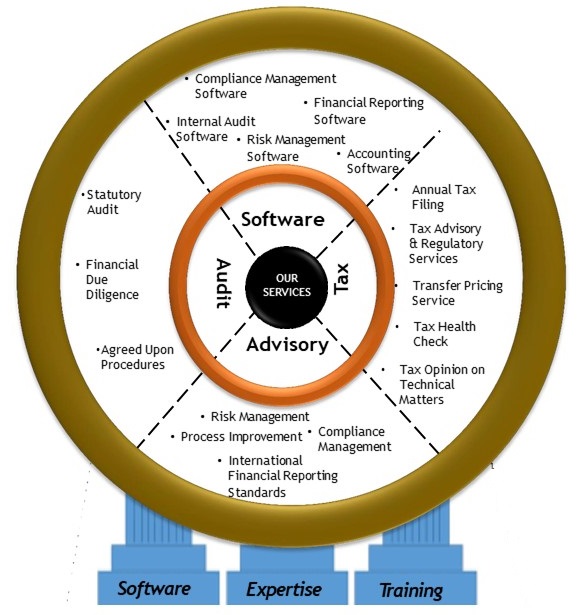
PML is a professional service firm providing services and solution in audit, tax, advisory and software. Our team is made up of seasoned and experienced professionals with several years of experience, providing risk and compliance, auditing, taxation, accounting services, financial advisory and other finance related services to clients across diverse industries including financial services, oil and gas, manufacturing, telecommunications etc.
Our services are built around specialized Software, Expertise and Training and tailored to take advantage of our combined “SET” approach.

PML has evolved over time and the business comprises of:

  • PML Professional Services – firms of chartered accountants
  • PML Advisory – focus on specialized software services
  • PML Outsourcing – focus on the human capital outsourcing services

At PML, we treat every client as unique and work closely to customize a solution to help solve problems, implement and drive change. Our Big Four heritage has given us a wealth of experience in all areas of finance and accounting services.
With our highly trained staff who are abreast of current issues in the financial world, we are ready to be of service to you.

Keep In touch!!

Our Statement

As a firm focused on quality service, we are confident that we have the ideal mix of expertise, resources and knowledge needed to continue to deliver proactive industry-specific services that you deserve.

Our Vision

To help our clients and people succeed and realize potentials.

Our Mission

To provide professional services to middle market in the areas of audit, tax, advisory and specialized software.

About Us

"Not every customer who owes you today will pay you tomorrow."

This simple reality is the foundation of Expected Credit Loss (ECL) under IFRS 9 – Financial Instruments.

Unlike the old IAS 39 model, which recognised losses only after a default occurred, IFRS 9 introduced a forward-looking approach. Rather than waiting for customers to default, entities are required to estimate potential credit losses using historical data, current conditions, and reasonable forecasts of future economic events.

The Three-Stage ECL Model

IFRS 9 classifies financial assets into three stages based on changes in credit risk:

This ensures that impairment provisions reflect changes in credit quality throughout the life of a financial asset.

Why Economic Conditions Matter

Expected Credit Losses are influenced by more than historical payment patterns. IFRS 9 requires entities to consider forward-looking information, including inflation, interest rates, exchange rate movements, unemployment, and overall economic conditions.

As these factors worsen, the likelihood of customer default increases, often resulting in higher impairment provisions—even before any actual default occurs.

Illustrative Example

ABC Limited has trade receivables of ₦100 million and initially estimates an Expected Credit Loss of 2%, resulting in an impairment allowance of ₦2 million.

As inflation rises and customers experience cash flow challenges, management revises its expected loss rate to 6%. Consequently, the impairment allowance increases to ₦6 million, despite no customer having defaulted.

This demonstrates the essence of IFRS 9: recognising expected losses rather than waiting for actual losses to occur.

Why It Matters

Expected Credit Loss is more than an accounting requirement—it is a proactive risk management tool. By recognising potential losses early, organisations improve the reliability of their financial statements, strengthen credit risk management, and provide investors with a more realistic view of financial performance.

Final Thought

Economic uncertainty is inevitable, but delayed recognition of credit risk should not be.

The Expected Credit Loss model under IFRS 9 encourages entities to move from a reactive to a forward-looking approach, ensuring that financial statements reflect both today's realities and tomorrow's risks.

In an uncertain economy, the strongest financial statements are those that anticipate risk—not merely report it.

JOIN OUR FREE NEWSLETTER