


From Spreadsheets to Strategy: Business Performance with sage ERP
For years, Microsoft Excel has been the unsung hero of the corporate world. It is flexible, familiar, and accessible to everyone from interns to CFOs. However, as mid-sized and growing enterprises in Nigeria navigate an increasingly complex economic and regulatory environment, relying on fragmented spreadsheets for core business operations has become a significant vulnerability.
When a business reaches a certain scale, the tools that facilitated its early growth can begin to restrict its progress. Managing inventory, tracking multi-currency transactions, reconciling bank statements, and preparing financial reports across multiple workbooks creates data silos, increases human error, and leads to critical delays.
To thrive in today’s market, organizations must transition from spreadsheets to strategy—moving away from reactive data gathering and toward proactive business performance management. The most effective catalyst for this transformation is a robust Enterprise Resource Planning (ERP) solution, such as Sage 300c or Sage 200 (Evolution).
The Hidden Costs of “Spreadsheet Management”
While spreadsheets appear cost-effective on the surface, they carry substantial hidden operational costs:
- The “Single Version of the Truth” Dilemma: When different departments (Sales, Warehouse, Finance) maintain separate Excel sheets, variations in numbers inevitably arise. Discrepancies often lead to meetings spent debating whose data is correct rather than deciding how to grow the business.
- Data Vulnerability and Broken Formulas: A single accidental keystroke or a broken cell reference can compromise an entire financial model. Tracking down these errors wastes valuable hours for accounting teams.
- Lack of Real-Time Visibility: Manually compiling data from various spreadsheets means reports are often outdated by the time they reach executives. Making strategic decisions based on month-old data limits agility in a fast-moving economy.
How Sage ERP Drives Strategic Transformation
Implementing an ERP solution like Sage 300c or Sage 200 changes the role of finance and operations teams. Instead of spending 80% of their time inputting and reconciling data, teams can focus on strategic analysis and performance improvement.
1. Automated Operations & Inventory Control
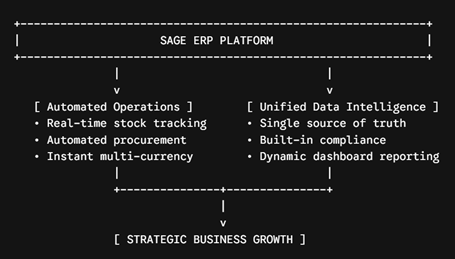
A major challenge for growing businesses is managing inventory without over-purchasing or stocking out. Sage ERP automates inventory tracking across multiple warehouses in real-time. When a sales order is processed, inventory levels update automatically, and procurement triggers are initiated based on minimum stock thresholds. This optimization improves working capital by reducing unnecessary inventory holding costs.
2. Streamlined Financial Reporting & Multi-Currency Management
For businesses operating across borders or dealing with volatile exchange rates, manual multi-currency adjustments are labor-intensive. Sage ERP automates foreign exchange revaluations, tracks multi-currency transactions smoothly, and generates IFRS-compliant financial statements with minimal manual intervention.
3. Integrated Business Intelligence (BI) for Strategic Decisions
The ultimate value of transitioning to Sage ERP is the analytics capability. Instead of looking at static historical spreadsheets, decision-makers have access to dynamic dashboards showing real-time Key Performance Indicators (KPIs). Leaders can instantly monitor gross profit margins, inventory turnover ratios, and departmental expenditure against budgets, allowing for rapid adjustments to market conditions.
Aligning with Nigeria’s Evolving Regulatory Landscape
The shift from manual tracking to an integrated ERP system is also driven by regulatory compliance. For instance, the transition to the Nigeria Tax Act (NTA) and the deployment of the Electronic Fiscal System (EFS) place a strong emphasis on digital transparency and real-time sales reporting.
Relying on manual spreadsheets leaves businesses exposed to compliance errors, late filings, or discrepancies during audits. Sage ERP provides automated audit trails, transparent transaction tracking, and integrated payroll structures (via Sage Payroll & HR) to ensure your business remains fully compliant with current statutory requirements.
Elevating the Role of the Finance Team
When operations are integrated into a single system, the finance team’s daily workflow shifts focus significantly:
- Old Approach (Spreadsheets): Extracting data – Copy-pasting – Fixing broken formulas – Reconciling data silos – Generating historical reports.
- Strategic Approach (Sage ERP): Reviewing real-time dashboards – Analyzing variance against budget – Managing cash flow forecasts – Identifying cost-saving opportunities – Partnering with leadership on business expansion.
Partner with PML professional services for Your ERP Journey
Transitioning from spreadsheets to an ERP system involves more than just purchasing software; it requires a deep understanding of your business processes, proper system configuration, and effective team training.
At PML professional services, our multidisciplinary team brings extensive experience in audit, tax, and advisory services to every implementation project. We work closely with you to deploy, customize, and support Sage 300c, Sage Evolution (Sage 200), and Sage HR & Payroll Solutions to ensure your system fits your specific operational workflows.
Don’t let manual spreadsheet processes limit your organization’s potential. Let us help you unlock real-time visibility, automated efficiency, and data-driven strategic growth.